This is just a note to let my loyal fan base know that I will be out of town for training until this Friday, so blogging may be light- to non-existent.
I'm taking a class on developing Web Portals.
In honor of Portals, my wife has suggested that I bring along our copy of Alice's Adventures in Wonderland and Through the Looking Glass. Hopefully I'll be able to report that there's more nonsense in the book than in the training. :-)
Monday, December 10, 2007

Saturday, December 8, 2007
Stuff and Such
I have a few items of family news to report.
First, today was the birthday party for the Adrenaline Junkie! Her actual birthday is tomorrow, but today was the convenient day for everyone to come to the birthday party, so today it was.
The party itself was a laid-back family affair. We're not into having huge birthday extravaganzas, as so many parents these days seem to be. We just decorated this morning with whatever we happened to have on hand, which primarily consisted of construction paper.
What can you do with construction paper?
Well, you can cut it into big, thin spirals, and hang them from whatever surface you can.

First, today was the birthday party for the Adrenaline Junkie! Her actual birthday is tomorrow, but today was the convenient day for everyone to come to the birthday party, so today it was.
The party itself was a laid-back family affair. We're not into having huge birthday extravaganzas, as so many parents these days seem to be. We just decorated this morning with whatever we happened to have on hand, which primarily consisted of construction paper.
What can you do with construction paper?
Well, you can cut it into big, thin spirals, and hang them from whatever surface you can.
This is very festive! It didn't take a whole lot of work to set up, and the kids thought it was totally engrossing when the ceiling fan was turned on. (Personally, I thought it was totally engrossing when the ceiling fan was turned on high, but we didn't leave it like that for very long. That would have been a little too festive).
We had both sets of grandparents up, and an uncle from Tonya's side of the family. As I said, a fairly laid-back affair. But note that the guests who did show up tend to be the ones who bring the most gifts. The Junkie made out like a bandit.
...
The Happy Boy (age 10 months) did something today that he hasn't done before, which indicates to us that something "clicked" in his brain. (This seems to be the way little kids develop: one day, they just start doing something they were unable to do before. How does it happen? We don't know; it just does, like someone threw a switch, and now they have a new level of consciousness.)
The Happy Boy had bumped something and fallen over, and was crying pretty hard--and pouting when he wasn't crying. So, while Mommy was holding him, and the two of us were trying to console him, I scrunched up my face into a pout, too, with my lower lip sticking out.
He looked at me like I was weird or something.
Then I guided a finger of his to my protruding lower lip, and had him push it back in. He found this a fascinating concept. He stopped crying.
So, I stuck my lower lip out again and started pouting. And.... the Happy Boy reached up, and pushed my lip in again. Then we both started giggling.
Then we did it again, and again... and each time, it got funnier and funnier to the Happy Boy who obviously thought: this is such a wonderful game! I can make my Daddy stop pouting with just a push of my finger! I have power!
Now, I found this fascinating, because he's now doing something he hasn't before. It's a new kind of social interaction: he is learning that he can affect other people's moods. He's noticing that he can do things that other people find funny. He's recognizing a certain social situation, and remembering the proper action for this situation, and anticipating the results. I hadn't seen him think like this before.
Tonya has been thinking that he's acting like he's understanding what we're saying much more often. At some point, a parent notices these things: you say something, and he starts to act in a way that tells you he understands. For example, I told him to take a toy out of his mouth today, and he did--the first several times, at least. (Then he started to ignore me--he's teething, after all--and so I had to get physical with him.) It really is fascinating to watch him develop.
And no, he hasn't started walking yet. He's by no means late, and we're totally content with how he's doing; but his sisters were walking by his age. We can tell he's really really close, though; about a week ago, he took a couple of steps by accident, without realizing what he was doing. But Mommy thinks it's likely to happen within the next week.
Then he'll start chasing me around to push my lip in. :-)
Friday, December 7, 2007
More Gadgetry
As a harp player, I can definitely concur with the verdict of (I think it was) Igor Stravinsky, who said, "Harpists spend 90% of their lives tuning their harps and the other 10% playing out of tune."
Keeping a harp in tune can be tricky. For one thing, there are a whole lot of strings on a harp. The most strings you get on a guitar is 12; the fewest strings I've seen on the smallest Celtic harps is 22. My Dusty has 36; full-sized orchestral harps often have 47. That's a lot of strings to keep in tune.
(Incidentally, to get a sense of what my big harp looks like, go to this page and look at the bottom pictures, of harps made of bubinga.)
For another thing, all but the smallest harps use multiple types of strings. My Dusty has many nylon monofilament strings; it has several strings with nylon monofilament cores with nylon wrappings to add mass (giving them rougher textures); and six strings or so with bronze cores and nylon wraps. All these strings react to changes in temperatures differently. If a cold breeze hits the harp, the metal-core strings all try to contract, and the tension goes up, causing them to go sharp; this doesn't immediately happen to the nylon strings. But eventually the wood starts to cool off and contract slightly, causing all the strings to relax a little and go flat. The net effect is for the the bass strings to go sharp and the others to go flat, and this can happen rather quickly and unpredictably.
Many harps--including the higher-end ones--use a couple octaves' worth gut strings in the middle-range. Gut tends to continue stretching throughout the life of the string; it must be tuned a little tighter every time you play it, until the strings eventually break. The gut strings also tend to be very sensitive to moisture in the air.
One other factor that makes harps hard to tune--at least, it did before the creation of electronic tuners--is that vibrations in one string cause other strings with compatible harmonics to start vibrating automatically. And the strings don't have to be perfectly in tune for this to happen; plucking one string causes many others to start sounding, so long as it's within a few cycles per second of the optimal tuning. This makes it difficult to tell whether you have it in pitch or not. One string may be a few cycles per second flat, but it will cause the previously-tuned strings to play, obscuring the fact that you're still a little out of tune. Thankfully, this problem was mostly solved when electronic tuners came in. (Although, for those with over-evolved tastes in music, this causes new problems, since the electronic tuners give you a tempered tuning, and tuning by ear gives you a system based on perfect fifths, which sounds just a wee bit different. As I said, though, modern audiences have to be over-evolved to notice this. Bach would probably cringe, though.)
Anyway, it was with great interest that I saw this:

It would seem that Gibson has come out with a model called the "Robot Guitar" that has a built-in tuning mechanism. From the moment it recieves the command, it can tune itself in a couple of seconds. They apparently incorporate an electronic tuner into the guitar, and use it to drive little servo motors attached to the tuning pins.
The guitar runs for about $2500.
So naturally, I started thinking about what it would take to put this sort of thing on a harp.
I think the answer is: a heckuva lot more than $2500. Every single one of those tuning pins--36 on my dusty, 47 on a full-sized Concert Pedal Grand Harp--would need a servo motor and some mechanism to sound the string. And (especially on the harps that don't have pedals) you'd need some way of specifying which tuning scheme you want to use. I use E-flat, but some people use C or something more exotic, especially when doing non-traditional music. And of course, there are plenty of over-evolved snobs who don't want their harps done with (sniff...) tempered tuning.
Furthermore, installation of these servo motors would weaken the arch. All those tuning pins have a way of acting as a row of splitting wedges on the arch of any normal harp; splits in the arches are a fairly common harp repair as it is. Removing even more material from the arch to accomodate the motors would weaken it further.
Add that to the fact that my Dusty would cost $5145.00 to buy it new, without any newfangled, high-falutin tuning mechanism.
So, maybe it's not too practical. Ah, but one can dream...
Keeping a harp in tune can be tricky. For one thing, there are a whole lot of strings on a harp. The most strings you get on a guitar is 12; the fewest strings I've seen on the smallest Celtic harps is 22. My Dusty has 36; full-sized orchestral harps often have 47. That's a lot of strings to keep in tune.
(Incidentally, to get a sense of what my big harp looks like, go to this page and look at the bottom pictures, of harps made of bubinga.)
For another thing, all but the smallest harps use multiple types of strings. My Dusty has many nylon monofilament strings; it has several strings with nylon monofilament cores with nylon wrappings to add mass (giving them rougher textures); and six strings or so with bronze cores and nylon wraps. All these strings react to changes in temperatures differently. If a cold breeze hits the harp, the metal-core strings all try to contract, and the tension goes up, causing them to go sharp; this doesn't immediately happen to the nylon strings. But eventually the wood starts to cool off and contract slightly, causing all the strings to relax a little and go flat. The net effect is for the the bass strings to go sharp and the others to go flat, and this can happen rather quickly and unpredictably.
Many harps--including the higher-end ones--use a couple octaves' worth gut strings in the middle-range. Gut tends to continue stretching throughout the life of the string; it must be tuned a little tighter every time you play it, until the strings eventually break. The gut strings also tend to be very sensitive to moisture in the air.
One other factor that makes harps hard to tune--at least, it did before the creation of electronic tuners--is that vibrations in one string cause other strings with compatible harmonics to start vibrating automatically. And the strings don't have to be perfectly in tune for this to happen; plucking one string causes many others to start sounding, so long as it's within a few cycles per second of the optimal tuning. This makes it difficult to tell whether you have it in pitch or not. One string may be a few cycles per second flat, but it will cause the previously-tuned strings to play, obscuring the fact that you're still a little out of tune. Thankfully, this problem was mostly solved when electronic tuners came in. (Although, for those with over-evolved tastes in music, this causes new problems, since the electronic tuners give you a tempered tuning, and tuning by ear gives you a system based on perfect fifths, which sounds just a wee bit different. As I said, though, modern audiences have to be over-evolved to notice this. Bach would probably cringe, though.)
Anyway, it was with great interest that I saw this:
It would seem that Gibson has come out with a model called the "Robot Guitar" that has a built-in tuning mechanism. From the moment it recieves the command, it can tune itself in a couple of seconds. They apparently incorporate an electronic tuner into the guitar, and use it to drive little servo motors attached to the tuning pins.
The guitar runs for about $2500.
So naturally, I started thinking about what it would take to put this sort of thing on a harp.
I think the answer is: a heckuva lot more than $2500. Every single one of those tuning pins--36 on my dusty, 47 on a full-sized Concert Pedal Grand Harp--would need a servo motor and some mechanism to sound the string. And (especially on the harps that don't have pedals) you'd need some way of specifying which tuning scheme you want to use. I use E-flat, but some people use C or something more exotic, especially when doing non-traditional music. And of course, there are plenty of over-evolved snobs who don't want their harps done with (sniff...) tempered tuning.
Furthermore, installation of these servo motors would weaken the arch. All those tuning pins have a way of acting as a row of splitting wedges on the arch of any normal harp; splits in the arches are a fairly common harp repair as it is. Removing even more material from the arch to accomodate the motors would weaken it further.
Add that to the fact that my Dusty would cost $5145.00 to buy it new, without any newfangled, high-falutin tuning mechanism.
So, maybe it's not too practical. Ah, but one can dream...
Thursday, December 6, 2007
Whole Lotta Nothin'
Haven't had a whole lot to say lately. We've been feeling physically and mentally dull.
Last night, Tonya just needed to unwind, so she played Civilization IV for much of the evening. Remember what I said about skill in siege engines and battlefield deception coming from my side of the family? Um... now that I think of it, it probably comes from both sides of the family. Maybe this is one of those points of commonality that make Tonya and me so well suited to each other.
But while Tonya was busy, um... organizing her foes out of existence last night, she was monopolizing the computer. Thus, no blog post.
Not that I had anything worthwhile to say.
So, for tonight, I might as well go for spectacle: According to Popular Mechanics, some company has invented what amounts to a high-tech sail that can be added to modern cargo ships to reduce their fuel consumption. Now, it's not like the sails of clipper ships; it's actually a gigantic cross between a kite and a parasail. But despite my skepticism that this system will ever actually get adopted in real life, it's still rather fun to think about.
Hope this can keep y'all tied over until I think of something real to write about. ;-)
Last night, Tonya just needed to unwind, so she played Civilization IV for much of the evening. Remember what I said about skill in siege engines and battlefield deception coming from my side of the family? Um... now that I think of it, it probably comes from both sides of the family. Maybe this is one of those points of commonality that make Tonya and me so well suited to each other.
But while Tonya was busy, um... organizing her foes out of existence last night, she was monopolizing the computer. Thus, no blog post.
Not that I had anything worthwhile to say.
So, for tonight, I might as well go for spectacle: According to Popular Mechanics, some company has invented what amounts to a high-tech sail that can be added to modern cargo ships to reduce their fuel consumption. Now, it's not like the sails of clipper ships; it's actually a gigantic cross between a kite and a parasail. But despite my skepticism that this system will ever actually get adopted in real life, it's still rather fun to think about.
Hope this can keep y'all tied over until I think of something real to write about. ;-)
Tuesday, December 4, 2007
Carnival of Homeschooling is Up!
The 101st Carnival of Homeschooling is up at Dewey's Treehouse. Both Tonya and I have posts featured.
The theme of this Carnival regards what people do when they're snowed in. Ironically enough, Tonya's post was listed under the heading "Some Do More School," and my post was listed under the heading "Some Do Less." Does this mean that Tonya does more than me? Um, er; uh...
yes.
Ahem. There were a lot of good posts, but the one that Tonya particularly liked was one entitled The 14 Days of Homeschooling, set to the tune of The 12 Days of Christmas.
Check it out!
The theme of this Carnival regards what people do when they're snowed in. Ironically enough, Tonya's post was listed under the heading "Some Do More School," and my post was listed under the heading "Some Do Less." Does this mean that Tonya does more than me? Um, er; uh...
yes.
Ahem. There were a lot of good posts, but the one that Tonya particularly liked was one entitled The 14 Days of Homeschooling, set to the tune of The 12 Days of Christmas.
Check it out!
My Daughter, the Anarcho-Capitalist
I've mentioned in the past that our five-year-old daughter has unusual thoughts on theology; that her writing displays a strong strain of Nihilistic Expressionism and predilections for surprise endings; that she has developed an interest in unencumbered human flight and airborne sheep rustling; and that she shows precocious talent in siege warfare and battlefield deception.
Now come two pieces of evidence that we have a full-blown Anarcho-Capitalist on our hands.
Item 1: For the Pillowfight Fairy's fifth birthday, her grandparents got her a copy of the book Six By Seuss, which contains six of Dr. Seuss's classic books in one volume. One of these is The Lorax, which of course is an environmentalist fable.
So, in the clash of wills between the Once-ler and the Lorax, which side do you think she takes?

You'll note, it's grammatically correct! We're so proud.
Good heavens.
Tonya, ever the optimist, thinks that this comes from the fact that most of her friends are boys. Frankly, I find that a little offensive. (She: "I grew up mostly around boys!" Me: "So did I.") I think this is proof of the doctrine of Original Sin. I also think it comes from her side of the family. (Except for the part about siege engines and battlefield deception--that's obviously me.)
We're trying to figure out a way of using her mental abilities for good, but this is going to stretch our mental resources. Maybe a career as a Demolitions expert? Or in Special Effects? Special Ops? Double agent? Counterrevolutionary? Illustrator of users' manuals for top-secret weaponry? Famous author of really depressing novels?
What do you think?
Now come two pieces of evidence that we have a full-blown Anarcho-Capitalist on our hands.
Item 1: For the Pillowfight Fairy's fifth birthday, her grandparents got her a copy of the book Six By Seuss, which contains six of Dr. Seuss's classic books in one volume. One of these is The Lorax, which of course is an environmentalist fable.
So, in the clash of wills between the Once-ler and the Lorax, which side do you think she takes?
 Yup, Thneeds. We all need them, you know. You really shouldn't try to stand in the way of progress. Not to mention that they come in such pretty colors!
She's mentioned to Mommy recently that she'd like to start learning how to knit at some point. This is probably because she thinks Thneeds are a really cool idea. Judging from the above sign, I think she may be considering starting up a business, environment be darned.
(I'm actually rather proud of that pun.)
Item 2: Now that we've established the Capitalist side of our little tyke, here's where we get evidence for the anarchist side. As part of her homeschooling, Mommy is giving her vocabulary words. Her job is to learn to spell them and then to write meaningful sentences that use them. One of today's vocabulary words was "blow".
Behold what emerged from the pencil of our sweet, precious little homeschooled darling:

You'll note, it's grammatically correct! We're so proud.
Good heavens.
Tonya, ever the optimist, thinks that this comes from the fact that most of her friends are boys. Frankly, I find that a little offensive. (She: "I grew up mostly around boys!" Me: "So did I.") I think this is proof of the doctrine of Original Sin. I also think it comes from her side of the family. (Except for the part about siege engines and battlefield deception--that's obviously me.)
We're trying to figure out a way of using her mental abilities for good, but this is going to stretch our mental resources. Maybe a career as a Demolitions expert? Or in Special Effects? Special Ops? Double agent? Counterrevolutionary? Illustrator of users' manuals for top-secret weaponry? Famous author of really depressing novels?
What do you think?
Monday, December 3, 2007
Thoughts Prompted by the Venezuelan Referendum
I'm not a political blogger. While I have pretty strong political views, I don't particularly want to put them on this blog for all the world to see. I suppose it's probably not hard to figure out what my leanings are from things I say incidentally, and from the various sites I link to in my posts; but if I started to blog on politics, I suspect I would have to spend several more hours a day brooding on things that make me mad, and that wouldn't be good for anyone--least of all me. So I do my best to leave political blogging to those who have the right temperament for it.
However, I do consider political philosophy to be fair game. What moves societies? What causes one person or party to have power, and another to lose it? What is the nature of political power? What causes a society to rise and then fall? What causes a government to rise and then fall?
About this time last year I was sent by my employer on a business trip clear across the country, to Lakehurst, New Jersey. (Yes, that is the site of the Hindenburg disaster. It's on the naval base there, and I got to see the site in person.) I took with me a little light reading material: Sun Tzu's The Art of War, and Niccolo Machiavelli's The Prince. I joked to my friends that I was learning How To Win Wars and Influence People. (On the way home, I delved into C.S. Lewis's The Problem of Pain. By the time I got home, my brain was mush).
So I was watching the Venezuelan constitutional referendum this weekend with great interest, and hoping--for the sake of the Venezuelan people, and not just for our own benefit--that they would vote "No." Of course, I was remembering the old dictum that "He who casts a vote decides nothing; he who counts the vote decides everything." I would be astounded to find out that there weren't any behind-the scenes shenanigans to tip the election in the direction that President Chavez wanted, and was actually pretty surprised that the government allowed the official result to come out the way it did. Nevertheless, I think it's pretty clear that the Venezuelan people just dodged a huge threat to their civil and political liberties.
...
The most important questions in all of politics--and they have been the most important questions since before the time of Hammurabi--are those dealing with who has the power and how far does that power extend. Consider the following list of questions:
However, I do consider political philosophy to be fair game. What moves societies? What causes one person or party to have power, and another to lose it? What is the nature of political power? What causes a society to rise and then fall? What causes a government to rise and then fall?
About this time last year I was sent by my employer on a business trip clear across the country, to Lakehurst, New Jersey. (Yes, that is the site of the Hindenburg disaster. It's on the naval base there, and I got to see the site in person.) I took with me a little light reading material: Sun Tzu's The Art of War, and Niccolo Machiavelli's The Prince. I joked to my friends that I was learning How To Win Wars and Influence People. (On the way home, I delved into C.S. Lewis's The Problem of Pain. By the time I got home, my brain was mush).
So I was watching the Venezuelan constitutional referendum this weekend with great interest, and hoping--for the sake of the Venezuelan people, and not just for our own benefit--that they would vote "No." Of course, I was remembering the old dictum that "He who casts a vote decides nothing; he who counts the vote decides everything." I would be astounded to find out that there weren't any behind-the scenes shenanigans to tip the election in the direction that President Chavez wanted, and was actually pretty surprised that the government allowed the official result to come out the way it did. Nevertheless, I think it's pretty clear that the Venezuelan people just dodged a huge threat to their civil and political liberties.
...
The most important questions in all of politics--and they have been the most important questions since before the time of Hammurabi--are those dealing with who has the power and how far does that power extend. Consider the following list of questions:
- Who is the nominal head of the government?
- Who is the de facto head of the government?
- How do you make sure that the legitimate ruler is the one actually holding the power (as opposed to some "power behind the throne")?
- How did a ruler become the ruler (Hereditary succession? Election? Acclimation? Coup?)
- What is the legitimate scope of the ruler's powers?
- How is a ruler prevented from misusing his powers or assuming powers he shouldn't have?
- How can a ruler be removed from office (Election? Assassination?)
- How does a civilian government maintain control of the military, when the military has all the guns? (This problem comes up a lot....)
- In a democracy, how do you keep the ruler from just cancelling elections and staying in power indefinitely? (This happens more likely than we want to think about....)
- In a divided government, how do you keep each branch of government from overstepping their bounds?
- Given that liberties of the people are nearly always inconvenient to those in power, how do you keep those in power from eroding those liberties?
All these questions, and many more like them, can be summed up in the question: "Who makes the decisions around here?" And like I said, this is (and has always been) the most important question in politics, far more important than any mere policy question. Many, many wars have been fought over the question of who's in charge.
After all, consider what happens if you answer the above questions wrongly. Do you have an opinion on some political question--say, abortion? If your political system answers the above questions correctly, you may have a voice. You may have Representatives who are accountable to you, who will take your views and those of your countrymen into account when the laws are being written. But if your political system answers the above questions wrongly, you may have no say whatsoever in the political questions of the day. Worse, the government may well tell you what to believe, and visit ruin upon you if you are so impertinent as to object to their beneficent guidance. In fact, the government may visit ruin upon you if one day you merely look cross eyed at a low-level bureaucrat.
The genius of the American Constitution lies in the fact that the drafters started with the idea that whatever offices existed in the new government, sooner or later these offices would be filled with scoundrels. If the rights and liberties of the people were to be maintained, then, the government had to be designed from the outset to mitigate any conceivable abuse of power that anyone in any office might try to commit. And they recognized that it was not enough to say that "Branch XYZ shall be forbidden from doing this," it was necessary to outline a governmental mechanism that would actively prevent Branch XYZ from doing what it wasn't supposed to.
So our government has power split up into numerous competing centers. There are mechanisms to prevent each of the three governmental branches from overstepping the powers granted to the others. There are also mechanisms to prevent the states from overpowering the feds, and (prior to the amendment providing for direct election of the Senators) mechanisms to prevent the feds from overpowering the states. There are mechanisms to prevent the People from overpowering the system and instituting mob rule, and lots of mechanisms to prevent the government from overpowering the system and instituting a tyranny. It's not a perfect system, but it's a very robust system, that's actually pretty effective at capping the damage that we fallen humans can cause when we get into positions of power.
Now note that all these checks and balances are really inconvenient to people in positions of power. And for that matter, the very concept of liberty is inconvenient to rulers. Who do they think they are to tell me "No!" After all, if you're in a position of power and are trying to reform society according to some deeply held moral vision you have, it never seems fair that the People can respond to your latest attempt at "benevolent guidance" with a resounding Raspberry--or, let alone, that they can organize to throw you out of positions of power, ending not just your dreams of reform, but also your career, for crying out loud.
The drafters of the American Constitution understood all this, which is why the document spends so much of its time answering the above list of questions about power, and very little time addressing actual questions of policy.
...
So very often, would-be tyrants try to pull a fast one on their would-be subjects. They offer a bargain along these lines: "We will write these popular policy guarantees into the Constitution, if you will allow us to make these little structural changes that will allow us to carry out our new duties...."
So on the policy side of things, they offer guarantees about housing, or health care, or pensions, or wealth redistribution--things that are popular, that appeal to most people.
But on the "structural" side of things, they remove the governmental obstructions to their exercise of power. The late Venezuelan referendum would have secured the ability of El Presidente to pick whatever regional councilmen he wanted, and the ability of El Presidente to nationalize whatever property he wanted, and the ability of El Presidente to institute perpetual States of Emergency that would allow rule by personal fiat, and the ability of El Presidente to stay in office for life.... In short, any effective check against the power of the presidency was to be scrapped. At some point a ruler in this political situation would be able to scrap the constitution and simply do whatever he wished, and the People would lose any ability to stop it, short of rebellion (against the army, which of course has all the guns).
So I think that tentative congratulations are in order for the people of Venezuela, with the caveat in place that they're not out of the woods yet. After all, they're still being ruled by a man who doesn't suffer lightly even the slightest opposition.
...
But note that this sort of thing--the offer to institute popular policy guarantees in exchange for a weakening of the checks and balances crucial to the preservation of liberty--is not just limited to Latin America. My understanding of the European Constitution is that it fits this paradigm quite nicely. And there's plenty of stuff that emanates from Washington D.C. that fits this pattern, which I'm not going to go into at this time (since this isn't a political blog, remember?). :-)
We Westerners--Americans in particular, but most Western Europeans and Anglosphere members--have lived in relative security and prosperity for at least two generations. It's tempting for us to look at the world immediately around us and say, "we've arrived." One occasionally hears phrases such as "The End of History" bandied about. When we read history, we read of the terrible conditions that existed in times prior to our own, when whole continents were ravaged by wars; when succession crises could arise literally overnight and throw entire empires into disarray; when infectious diseases were common and famines were semi-common. And we blithely think to ourselves, "I'm really glad we didn't live then." But we just assume that these problems belong to the past. We figure we don't deserve to have to deal with famines or infections diseases; we've fixed those problems. The very thought of hostile armies tromping across our lands seems like geek fantasy--nothing to take seriously, since it's been well over a century since anything like that has happened here in America. We start worrying about things way up Maslow's Hierarchy of Needs, but we tend to take the bottom layers of this Hierarchy for granted.
We only have the luxury of taking these bottom layers for granted because the people who came before us faced these problems head-on and came up with workable solutions. Our generation is not exempt from the laws of history, though, and there's nothing to keep these problems from coming back with a vengeance, except our own vigilance. Likewise, Americans have enjoyed liberties nearly unprecedented in human history, and we often take them for granted; but this is only because the drafters of the constitution didn't take them for granted. And if we want to pass on our liberties to the next generation, we don't actually have the luxury of taking them for granted. We have a responsibility to understand just how it is that our Constitution is designed to preserve our liberties, and recognize and oppose any scheme that tries to trade us attractive policy goodies in exchange for a weakening of any restriction on governmental power.
I Demand Dur Frocess!
As someone who's been blogging for all of 3.5 months now, it's become increasingly obvious to me just how fiendishly difficult it is to keep everything well-edited.
Here's what happens. I write a long post on something. I pour out my heart and soul into my writing; I agonize over every word and phrase; I delete whole paragraphs when I don't like the direction they're going; I rewrite, rearrange, and occasionally restart.
Then, when I have it mostly the way I want it, I usually (but not always) run the spell checker. I'm a pretty good speller most of the time, and my errors--when I make them--are usually of the "I can't believe I did that" variety. But then I read it--often out loud to my lovely bride, who (if I'm lucky) is still awake by this point--to catch any other errors in punctuation, word choice, spelling, and general editing. She calls me on passages that sound obnoxious, and I do more rewrites.
Then I publish the post.
The following morning, I read what I've written, and am usually appalled at all the errors that have slipped through. I read that thing three times! How could I have possibly missed that!
So I found a couple of posts over at the Volokh Conspiracy this morning to be especially funny. For those of you who aren't familiar with it, the Volokh Conspiracy is a group blog with a decidedly libertarian viewpoint, headed by UCLA Law Professor Eugene Volokh, that covers contemporary legal issues.
The first post is entitled The Due Frocess Clause. This post (and make sure you go through all the comments!) amply demonstrates that some lawyers really do have senses of humor.
The second post is entitled Update on the Power and Majesty of the Due Frocess Clause, and it demonstrates that some lawyers really do not have senses of humor.
Again, be sure to read the comments. You'll be astounded at what the Fondling Fathers had to say....
Here's what happens. I write a long post on something. I pour out my heart and soul into my writing; I agonize over every word and phrase; I delete whole paragraphs when I don't like the direction they're going; I rewrite, rearrange, and occasionally restart.
Then, when I have it mostly the way I want it, I usually (but not always) run the spell checker. I'm a pretty good speller most of the time, and my errors--when I make them--are usually of the "I can't believe I did that" variety. But then I read it--often out loud to my lovely bride, who (if I'm lucky) is still awake by this point--to catch any other errors in punctuation, word choice, spelling, and general editing. She calls me on passages that sound obnoxious, and I do more rewrites.
Then I publish the post.
The following morning, I read what I've written, and am usually appalled at all the errors that have slipped through. I read that thing three times! How could I have possibly missed that!
So I found a couple of posts over at the Volokh Conspiracy this morning to be especially funny. For those of you who aren't familiar with it, the Volokh Conspiracy is a group blog with a decidedly libertarian viewpoint, headed by UCLA Law Professor Eugene Volokh, that covers contemporary legal issues.
The first post is entitled The Due Frocess Clause. This post (and make sure you go through all the comments!) amply demonstrates that some lawyers really do have senses of humor.
The second post is entitled Update on the Power and Majesty of the Due Frocess Clause, and it demonstrates that some lawyers really do not have senses of humor.
Again, be sure to read the comments. You'll be astounded at what the Fondling Fathers had to say....
Saturday, December 1, 2007
Update On Our Homeschooling Effort
My lovely bride has posted a very thorough update on how our homeschooling effort is going. The post is here.
On the Futility of Human Endeavor
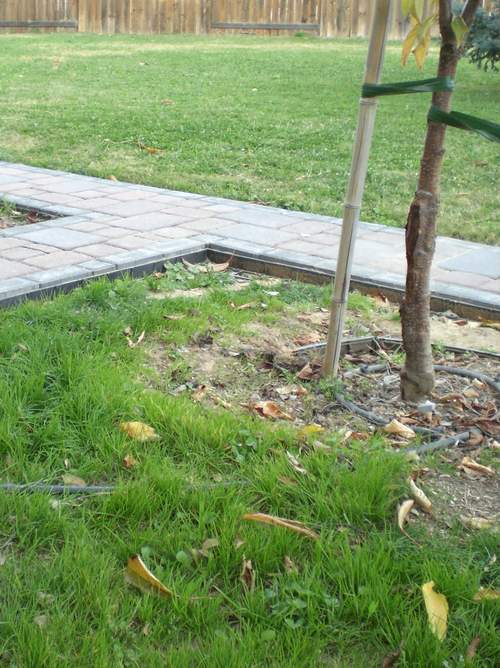
I present for your consideration the following photograph taken in our backyard, and I would like to draw your attention to the grass. Yes, that's right, the grass.

Notice: the grass in the background is of a dull green color, and laced with big patches of brown. If you could get up close and look at it, you would see that much of this "grass" consists of weeds--puncture vine, crab grass, Dallas grass, broadleaf weeds, dandelions, wild clovers, and even some wild mint. In some parts of the yard, there isn't that much actual grass present--it's all weed.
Notice: the grass in the foreground is of a rich, deep, lush green color. There is a little bit of broadleaf weed present, but not a whole lot; most of what's there is honest-to-goodness, thin-leaf grass.
Now, this is a source of no end of bewilderment and frustration on our part. The yard on the other side of the walk, is where the grass is supposed to be greener. After all, that's where we have the sprinklers running; that's where we've re-seeded from scratch twice; that's where we've been mowing; that's where we've done all our fertilizing.
The yard on the near side of the walk, however, is intended to be part of a planter, in which we will ultimately be putting tree bark or mulch of some kind. All we've done to it is occasionally hit it with Round-Up to kill off all the weeds. Aside from that, we've been ignoring it; we've been walking and driving wheel-barrows all over it as I've been working on the walkway and patio. And yet, as soon as the winter rains started up this October, it sprouted some of the prettiest, lushest winter grass you've ever seen in your life. Our planters are, in most places, a whole lot prettier than our yard, where we've been fussing over the grass for several years now.
Do we just have that much of a brown thumb, or is this a case of God trying to tell us something?
Notice: the grass in the background is of a dull green color, and laced with big patches of brown. If you could get up close and look at it, you would see that much of this "grass" consists of weeds--puncture vine, crab grass, Dallas grass, broadleaf weeds, dandelions, wild clovers, and even some wild mint. In some parts of the yard, there isn't that much actual grass present--it's all weed.
Notice: the grass in the foreground is of a rich, deep, lush green color. There is a little bit of broadleaf weed present, but not a whole lot; most of what's there is honest-to-goodness, thin-leaf grass.
Now, this is a source of no end of bewilderment and frustration on our part. The yard on the other side of the walk, is where the grass is supposed to be greener. After all, that's where we have the sprinklers running; that's where we've re-seeded from scratch twice; that's where we've been mowing; that's where we've done all our fertilizing.
The yard on the near side of the walk, however, is intended to be part of a planter, in which we will ultimately be putting tree bark or mulch of some kind. All we've done to it is occasionally hit it with Round-Up to kill off all the weeds. Aside from that, we've been ignoring it; we've been walking and driving wheel-barrows all over it as I've been working on the walkway and patio. And yet, as soon as the winter rains started up this October, it sprouted some of the prettiest, lushest winter grass you've ever seen in your life. Our planters are, in most places, a whole lot prettier than our yard, where we've been fussing over the grass for several years now.
Do we just have that much of a brown thumb, or is this a case of God trying to tell us something?
Subscribe to:
Posts (Atom)
